In today’s hyper-connected world, brands can no longer rely solely on traditional data collection methods to understand their customers. With rising expectations for personalization and immediate service, the need for real-time insights into customer and employee sentiments has never been more urgent.
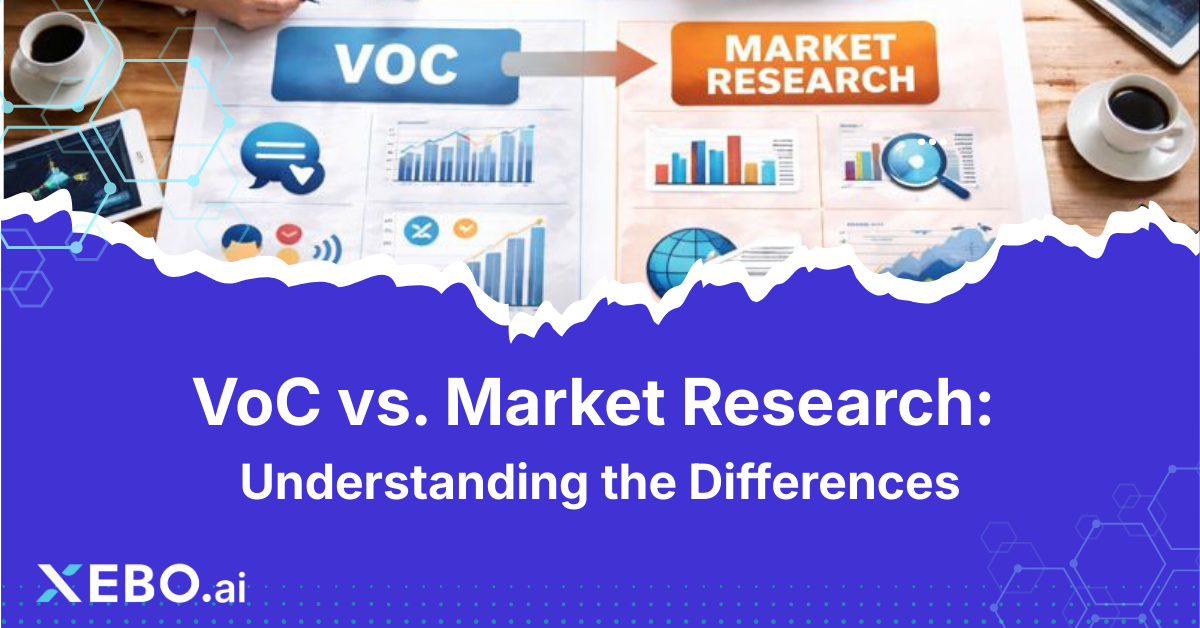
That’s where Voice of the Customer (VoC) and market research come into play. While both strategies aim to gather valuable feedback, their focus, methodology, and outcomes differ significantly. Knowing when and how to use each approach is essential for organizations looking to optimize customer experience, strengthen employee engagement, and stay ahead in competitive markets.
This article unpacks the key differences between VoC and market research, helping you understand how both contribute to your overall feedback management strategy, and how a modern VoC platform can amplify your impact.
Voice of the Customer (VoC) refers to the process of collecting and analyzing direct, indirect, and inferred customer feedback to improve products, services, and experiences in real time. It is a proactive, often continuous practice that is deeply embedded within customer experience (CX) strategies.
A VoC platform enables brands to capture feedback through multiple channels, such as surveys, emails, social media, chat transcripts, call center recordings, and more. The goal is to gain a 360-degree view of customer sentiment and use that insight to drive action across departments, from marketing and customer service to product development.
Key characteristics of VoC:
Market research is the systematic gathering, analyzing, and interpreting of information about a market, product, or service. Its goal is to understand market dynamics, customer needs, industry trends, and competitive positioning.
While market research can involve customer feedback, it’s typically broader and more static, often involving detailed studies that span weeks or months. It is often used before launching a new product or entering a new market, and the findings are typically compiled into formal reports.
Key characteristics of market research:
Knowing when to use VoC or market research depends on your business goals.
Use VoC when:
Use market research when:
In many cases, organizations benefit from combining both approaches. For example, use market research to understand a target segment before product launch, then deploy a Voice of the Customer program to continuously refine and improve the experience post-launch.
Traditional market research is still valuable, but it often lacks the agility today’s brands need. Customer expectations evolve rapidly, and a delayed insight can cost you loyalty, revenue, or both. That’s why more companies are investing in VoC platforms and moving away from generic solutions like Qualtrics or Medallia in favor of best-in-class, customer-first alternatives.
A modern VoC platform enables you to:
VoC is no longer just a tool, it’s the backbone of customer and employee experience strategies.
While VoC focuses on external stakeholders, employee experience (EX) is equally vital. Engaged employees deliver better service, which directly impacts customer satisfaction. By using employee experience software alongside your VoC tools, you can get a holistic view of the organizational ecosystem.
A strong feedback management platform integrates both customer and employee insights, enabling you to identify misalignments, operational friction, and culture gaps before they impact your business.
For many companies, switching to a next-gen Qualtrics alternative or Medallia alternative has become a strategic necessity. Legacy platforms can be cumbersome, inflexible, and expensive. In contrast, the best VoC platforms today are lightweight, scalable, and offer more automation, faster time-to-value, and better analytics.
Features to look for in a modern VoC and employee survey platform:
By investing in a customer survey platform that also functions as an employee survey software, you align both arms of the experience equation, your people and your customers.
VoC and market research serve distinct but complementary roles in understanding people—whether they’re your customers or employees. Market research is strategic and outward-looking, ideal for long-term planning. VoC, on the other hand, is tactical, dynamic, and laser-focused on improving customer experience at the moment.
The best approach isn’t choosing one over the other but rather integrating both into a cohesive strategy. A robust VoC platform gives you the power to act on what customers and employees are saying, right now, while market research gives you the long-range radar to anticipate what’s next.
If you're looking for a survey management platform, customer experience software, or a feedback management platform that’s purpose-built for modern businesses, it’s time to see what XEBO.ai can do for you.
Ready to hear the true voice of your customers and employees? Schedule a free demo with XEBO.ai