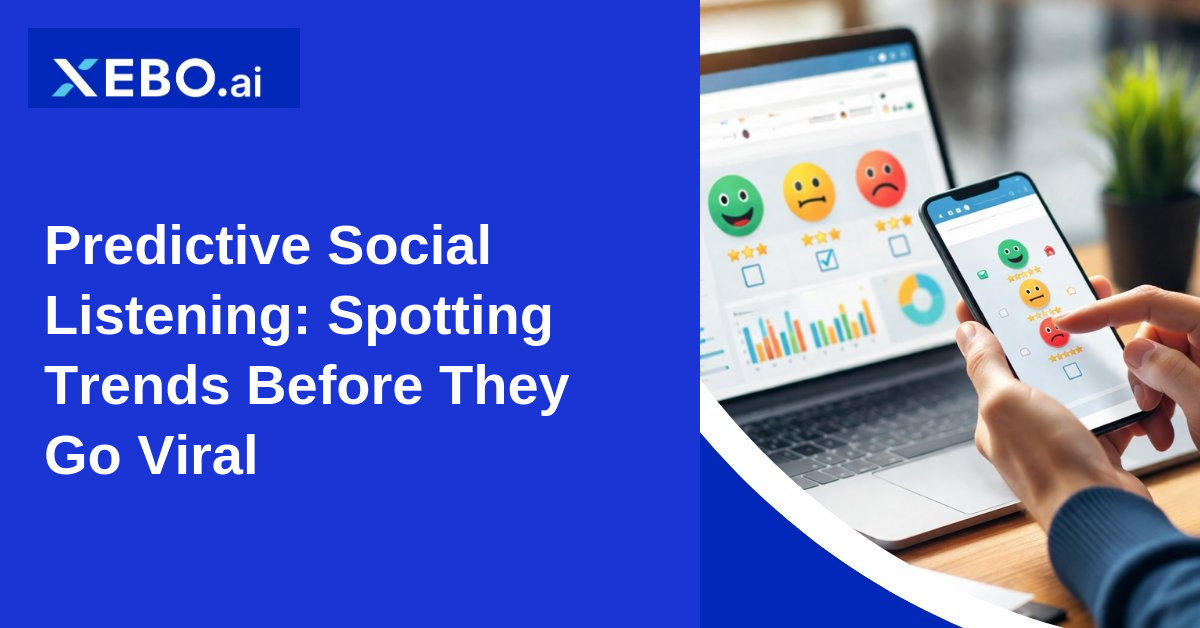
In the age of information overload, the brands that win aren't the ones who react fastest, they're the ones who see what's coming before anyone else does. Predictive social listening is the game-changer that separates market leaders from those perpetually playing catch-up. It's not just about monitoring conversations anymore. It's about decoding signals hidden in the noise and turning them into strategic advantage before a trend ever hits the mainstream.
Most businesses are familiar with social listening in its conventional form: tracking brand mentions, measuring sentiment, and keeping an eye on competitor activity. Useful, yes. But fundamentally reactive. You're looking at what already happened.
Predictive social listening takes an entirely different approach. By layering artificial intelligence, machine learning, and advanced natural language processing on top of social data, it identifies early-stage patterns, micro-signals, that indicate where conversations, consumer behaviour, and cultural moments are heading. Think of it as the difference between reading yesterday's newspaper and predicting tomorrow's headlines.
The technology analyses millions of data points across social platforms, forums, review sites, blogs, and news outlets simultaneously. It notices when a niche hashtag starts gaining traction in a specific community before it spills into mainstream feeds. It detects when a particular consumer concern is being whispered about in small circles, long before it becomes a PR crisis or a viral movement. That early warning window is where the real competitive advantage lives.
Trends don't explode out of nowhere. Every viral moment has a pre-viral lifecycle, a quiet incubation period where signals are weak but consistent. Predictive social listening tools are designed to catch this lifecycle at its earliest possible stage.
Here's how it works in practice. AI models are trained on historical trend data, mapping the behavioural and linguistic signatures of conversations that eventually go viral. These signatures include things like: the rate at which unique users are picking up a topic (velocity), the geographic spread of a conversation, the emotional intensity behind posts, and cross-platform migration, when a topic moves from Reddit threads to TikTok comments to Twitter/X debates, that's a powerful indicator that something is building.
Beyond volume metrics, predictive tools analyse contextual relevance. A spike in mentions means little without understanding the sentiment driving it, the demographics amplifying it, and the influencers giving it legitimacy. Machine learning models continuously refine their predictions by comparing emerging patterns against thousands of historical trend trajectories, learning to distinguish genuine momentum from temporary noise.
Here's a truth most marketing teams don't want to hear: by the time something is trending on Twitter or appearing in your weekly social report, the opportunity window is already closing. Early movers, brands and creators who identified the trend two weeks prior, have already captured the organic reach, the cultural clout, and the audience goodwill.
The viral moment is the tip of the iceberg. Predictive social listening lets you see the mass of ice underneath, the slow-building consumer sentiment, the emerging cultural narrative, the grassroots movement gaining momentum. Brands that act on these early signals can shape conversations rather than just participate in them. They become part of the story instead of chasing it.
This is particularly critical in high-velocity industries like fashion, food & beverage, consumer electronics, and entertainment, where trend cycles are measured in weeks rather than months. But it's equally valuable in B2B markets, where shifts in industry conversation, emerging pain points, and evolving buyer concerns can give sales and product teams a decisive head start.
The most forward-thinking brands are already integrating predictive social listening into core business functions, not just marketing, but product development, crisis management, and customer experience strategy.
In product development, teams are using early trend signals to inform feature roadmaps and product pipelines. When predictive tools flagged a rising consumer interest in "quiet luxury" aesthetics nearly six months before the term became ubiquitous, savvy fashion and lifestyle brands had already adjusted their collections and content strategies accordingly.
In crisis management, predictive listening is arguably even more valuable. Negative sentiment rarely erupts overnight. There's almost always a period of growing discontent, frustrated customers venting in niche communities, critical threads gaining quiet momentum. Catching these signals early gives brands the chance to address issues proactively, before a complaint becomes a campaign and a campaign becomes a crisis.
Customer experience teams are using predictive insights to anticipate what customers will need next, not just respond to what they're asking for today. This shifts the entire posture of CX from reactive support to proactive engagement, a transformation that drives measurable improvements in loyalty and satisfaction scores.
The raw data that social platforms generate is staggering. Without AI, it's simply unmanageable. What makes predictive social listening genuinely powerful is the intelligence layer that converts data into decisions.
Modern platforms use transformer-based NLP models to understand context and nuance in social language, including slang, sarcasm, cultural references, and emerging terminology that traditional keyword-based tools miss entirely. They use clustering algorithms to group related conversations and identify the narrative threads running through them. And they use predictive modelling to assign confidence scores to emerging trends, helping teams prioritise which signals warrant immediate action and which are still too early to call.
Crucially, the best predictive listening platforms don't just surface insights, they contextualise them. A trend signal means more when you understand which audience segment is driving it, what emotional need is behind it, and how it connects to your brand's positioning. That kind of contextualised intelligence is what turns social data from a reporting exercise into a genuine strategic asset.
Adopting predictive social listening isn't about deploying a tool and waiting for insights to arrive. It requires a deliberate strategy built around clear business objectives.
Start by defining the trend categories that matter most to your business. Are you most interested in emerging consumer preferences? Competitive intelligence? Potential reputational risks? Cultural moments relevant to your brand? Your focus areas will shape how you configure your listening parameters and how you interpret the signals you receive.
Next, establish a cross-functional insights loop. Predictive social data is most powerful when it flows beyond the marketing team, into product, customer success, communications, and executive strategy. Build a process for translating trend signals into briefings that relevant stakeholders can act on quickly.
Invest in building a trend taxonomy for your industry. Over time, tracking which early signals have historically led to significant trends gives your team a proprietary dataset that makes your predictions increasingly accurate. The brands that have been doing this for two or three years have a meaningful competitive edge over those just starting out.
Finally, measure the impact of early action. Track instances where predictive listening informed a decision and compare outcomes against situations where your team reacted to trends after they peaked. That data builds the internal business case for continued investment and helps refine your strategic approach.
Consumer attention is fragmenting. Platform algorithms are evolving constantly. Cultural moments are accelerating and collapsing in shorter cycles than at any previous point in marketing history. In this environment, brands that rely solely on lagging indicators, monthly reports, quarterly surveys, post-campaign analyses, are operating with a fundamental strategic disadvantage.
Predictive social listening doesn't eliminate uncertainty, but it dramatically narrows it. It gives marketing, product, and communications teams the lead time they need to make smarter decisions, allocate resources more efficiently, and show up in culture with relevance rather than irrelevance. In an era where authenticity and timing are everything, being ahead of the conversation is one of the most powerful positions a brand can occupy.
The question isn't whether your industry will be disrupted by shifts in consumer sentiment and cultural trends. It will be. The question is whether you'll see those shifts coming, or whether you'll be scrambling to respond after someone else has already claimed the moment.
Predictive social listening represents a fundamental evolution in how brands understand and engage with the world around them. It moves the needle from descriptive analytics, what happened, to predictive intelligence, what's about to happen. And in doing so, it gives forward-thinking organisations a tool that is genuinely rare in business: time.
Time to create. Time to adapt. Time to lead.
The brands building this capability now aren't just gaining a marketing advantage. They're building an organisational intelligence muscle that will compound in value with every trend cycle, every campaign, and every conversation they're part of before anyone else arrives.
Stop reacting to trends and start owning them. XEBO.ai helps brands harness the power of predictive social listening, identifying signals, surfacing insights, and giving your team the strategic lead time to act with confidence.
Schedule a Free Demo with XEBO.ai and discover how predictive intelligence can transform the way your brand listens, learns, and leads.
Your competitors are watching trends. It's time you started predicting them.