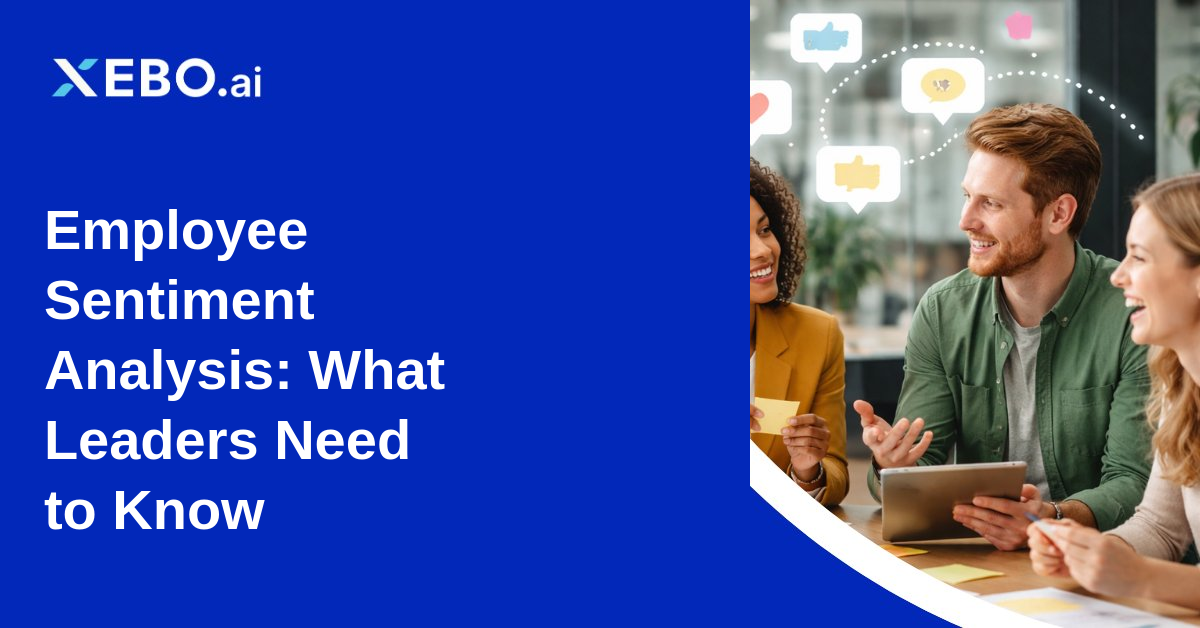
There's a conversation happening inside your organization right now, and chances are, you're not fully hearing it. It's not in the boardroom. It's not in the quarterly review. It's happening in the quiet frustration of a team leader who feels unheard, in the dwindling enthusiasm of a high performer who's eyeing the exit, and in the cautious silence of employees who've simply stopped volunteering their opinions.
Employee sentiment, how your people truly feel about their work, their managers, and the organization, is one of the most powerful and underutilized signals in business today. Leaders who learn to read it, measure it, and act on it don't just build better workplaces. They build stronger businesses.
Employee sentiment analysis is the process of capturing, interpreting, and acting on how employees feel, not just what they report when asked direct questions on an annual survey, but the underlying emotions, attitudes, and morale that drive behavior every day.
It goes well beyond the traditional "engagement score." While engagement measures whether employees are invested in their work, sentiment digs deeper: Are they satisfied? Do they feel psychologically safe? Do they trust leadership? Are they likely to stay, or are they quietly quitting?
Modern sentiment analysis leverages AI and natural language processing (NLP) to analyze feedback from multiple channels, pulse surveys, open-text responses, exit interviews, performance conversations, and more, and turns unstructured human language into actionable intelligence. The result is a real-time, nuanced picture of your organizational culture that no spreadsheet or HR gut-check can replicate.
Most organizations still rely on annual employee engagement surveys. And while these have their place, they come with a critical limitation: they're a snapshot, not a story.
By the time the data is collected, analyzed, and presented to leadership, it's often months old. The disengaged employee you could have retained has already resigned. The toxic team dynamic that was brewing has already damaged productivity. The manager whose communication style was eroding trust has already lost three high-potential team members.
Annual surveys also suffer from response bias. Employees who are most disengaged are often the ones least likely to complete a survey. And when they do, they may not feel psychologically safe enough to share their honest thoughts, especially in open-text fields where they fear being identified.
This is the gap that employee sentiment analysis is built to fill. It gives leaders a continuous, always-on pulse, not a once-a-year checkup.
This isn't a "soft" HR initiative. The numbers are stark.
Disengaged employees cost organizations an estimated 18% of their annual salary in lost productivity. Companies with high employee engagement outperform their peers by up to 23% in profitability. And voluntary turnover, much of which is preventable, costs employers anywhere from 50% to 200% of an employee's annual salary when you factor in recruiting, onboarding, and productivity loss.
Now consider this: a significant portion of voluntary turnover is driven by emotional and cultural factors, feeling undervalued, lacking growth opportunities, poor relationships with managers, or misalignment with company values. These are precisely the signals that sentiment analysis is designed to detect, early, before they become resignations.
When leaders have access to real-time sentiment data, they can intervene at the right moment. They can recognize when a department is burning out before absenteeism spikes. They can identify which managers are struggling with team morale before top talent walks. They can course-correct culture before it calcifies.
Sophisticated sentiment analysis platforms don't just categorize feedback as "positive," "negative," or "neutral." They go several layers deeper. Here's what leaders should expect to uncover:
Emotional tone and intensity. Not all negative feedback is equal. There's a difference between an employee who says "I wish we had better communication" and one who says "I feel completely invisible to leadership." Sentiment tools are calibrated to detect the emotional weight behind words, not just the words themselves.
Thematic patterns. When dozens of employees across different teams use similar language around concepts like "workload," "recognition," or "career growth," that's a signal, not noise. Sentiment analysis surfaces these themes before they become widespread pain points.
Sentiment trends over time. A single data point is interesting. A trendline is intelligence. Tracking sentiment longitudinally helps leaders understand whether morale is improving after a new initiative, declining in the wake of organizational change, or fluctuating in predictable cycles.
Segmented insights. Organization-wide sentiment scores can mask serious pockets of dysfunction. Advanced tools allow leaders to segment data by department, seniority level, location, tenure, and more, giving a far more precise and actionable view.
Drivers of sentiment. Understanding that morale is low is just the starting point. Knowing why, whether it's workload, leadership trust, pay equity, or lack of recognition, is what enables meaningful change.
One of the most significant barriers to accurate sentiment data is psychological safety, or the lack of it. Employees who don't trust that their feedback will remain confidential, or who fear retaliation for honest input, will self-censor. The result is sentiment data that paints a rosier picture than reality.
This is why the design of a sentiment analysis program matters as much as the technology behind it. Anonymity must be genuine, not just claimed. Employees need to see that feedback leads to visible action, or they'll stop providing it. And leaders need to model vulnerability, actively inviting criticism and responding to it constructively, before employees feel safe enough to be fully honest.
When psychological safety is in place, the quality and honesty of sentiment data improves dramatically. And with better data comes better decisions.
Even with the right tools in place, sentiment analysis programs can underdeliver if they're not implemented thoughtfully. Here are the most common mistakes leaders make:
Collecting without acting. Nothing destroys employee trust faster than sharing their feelings, watching the data get collected, and then seeing nothing change. Sentiment programs must be paired with clear feedback loops and visible action plans.
Over-indexing on the score. A sentiment score is a compass, not a destination. Leaders who become fixated on improving the number rather than addressing the underlying issues end up gaming the metric rather than improving the culture.
Treating it as an HR function, not a leadership function. Sentiment analysis is most powerful when it's embedded into how leaders operate, in team meetings, in one-on-ones, in strategic planning. When it lives only in an HR dashboard, it loses its potential to drive real change.
Ignoring qualitative data. Numbers tell you what is happening. The words employees use tell you why. Qualitative insights from open-text responses are often the richest and most actionable part of any sentiment dataset, and they're frequently underutilized.
The evolution from manual survey analysis to AI-powered sentiment intelligence has been transformative. Where humans can analyze a few hundred open-text responses with significant subjectivity and time investment, AI can process thousands of responses in seconds, detecting patterns, nuances, and emotional undertones that would otherwise go unnoticed.
Modern AI-driven platforms can analyze multilingual feedback without losing cultural context. They can flag early warning signals, like a sudden dip in sentiment in a specific team after a leadership change, in real time, giving managers a window to act before a situation escalates. They can also reduce human bias in interpretation, providing more consistent and objective analysis across the entire organization.
Perhaps most importantly, AI-powered sentiment tools are continuously learning. The more data they process, the sharper their ability to distinguish meaningful signals from background noise, and to surface insights that are genuinely predictive — not just descriptive.
Technology alone won't transform how your organization listens to its people. The real shift must happen at the leadership level. The most effective leaders treat sentiment data the way high-performing athletes treat biometrics, as a constant, non-negotiable input into how they train, recover, and perform.
This means reviewing sentiment trends with the same rigor as financial dashboards. It means building accountability structures where managers are evaluated not just on business outcomes but on the health of their teams. It means creating formal channels for acting on sentiment insights, and communicating those actions back to employees in a transparent, timely way.
It also means developing what might be called "sentiment literacy" across the leadership team: the ability to read between the lines of data, ask the right follow-up questions, and respond to emotional signals with empathy and decisiveness in equal measure.
Organizations that get this right don't just reduce attrition. They build cultures where people do the best work of their lives, and want to stay to keep doing it.
What Leaders Should Ask Before Choosing a Sentiment Analysis Platform
If you're evaluating tools to bring sentiment analysis into your organization, here are the questions that matter most:
Does the platform go beyond simple positive/negative categorization, or does it offer deep emotional and thematic analysis? How does it protect employee anonymity and build trust in the data collection process? Can it segment insights meaningfully, by team, location, tenure, or role? Does it integrate with your existing HR and communication systems? And critically, does it turn data into actionable recommendations, or does it just generate dashboards that require interpretation?
The right platform doesn't just show you numbers. It tells you what to do next.
The future of work is human. Amid all the noise about automation, AI, and digital transformation, the organizations that will thrive are those that understand something fundamental: their most important asset is not their technology or their strategy, it's the people who execute it every day.
Employee sentiment analysis is how forward-thinking leaders stay connected to that asset. It's how they build trust at scale, retain top talent in competitive markets, and create cultures that attract the kind of people who make organizations exceptional.
The leaders who invest in truly understanding how their people feel, and who build systems to act on that understanding, are the ones who will define what great leadership looks like in the years ahead.
The question is: are you ready to start listening?
Most organizations are making culture decisions in the dark. With XEBO.ai, you get the clarity you need, real-time sentiment insights, AI-powered analysis, and actionable recommendations that help your leaders move fast and move right.
Schedule Your Free Demo with XEBO.ai Today and see how the world's most people-forward organizations are turning employee sentiment into their greatest competitive advantage.
Your people are already talking. XEBO.ai helps you truly hear them.