The workplace has always been a complex social ecosystem. People bring their motivations, frustrations, ambitions, and anxieties to work every single day, and for decades, companies have struggled to truly understand what their employees feel. Annual surveys, town halls, and one-on-one check-ins were the best tools available. They were better than nothing, but they were slow, incomplete, and often too sanitised to be actionable.
Today, that is changing. Artificial intelligence is giving organisations an entirely new lens through which to understand their people, not just what employees say, but what they actually mean.
Let's be honest about why legacy feedback tools fall short.
Annual engagement surveys have a fundamental flaw: they capture how someone feels on one Tuesday in November. A lot can happen between surveys. People can go from fully engaged to quietly quitting in a matter of weeks, and no annual pulse would catch it in time. Response rates are also notoriously low; many employees simply don't trust that their feedback will lead to any real change, so they stop bothering.
Exit interviews, another classic tool, are perhaps the most ironic: you finally get candid feedback from an employee at the exact moment they're walking out the door. By then, it's too late to retain them.
Focus groups and town halls suffer from social dynamics; employees are reluctant to speak critically in front of peers or managers. The loudest voices dominate. Nuanced feelings get lost.
The result? A massive gap between what leadership thinks is happening inside the organization and what employees experience. That gap costs companies dearly, in productivity, turnover, innovation, and culture.
What makes AI genuinely transformative for employee sentiment analysis isn't just speed, it's depth and scale working together.
Traditional HR teams can only analyse a finite amount of qualitative data. Reading through thousands of open-text survey responses manually is practically impossible. So most of that data gets ignored or condensed into a number that loses all the texture of what people actually said.
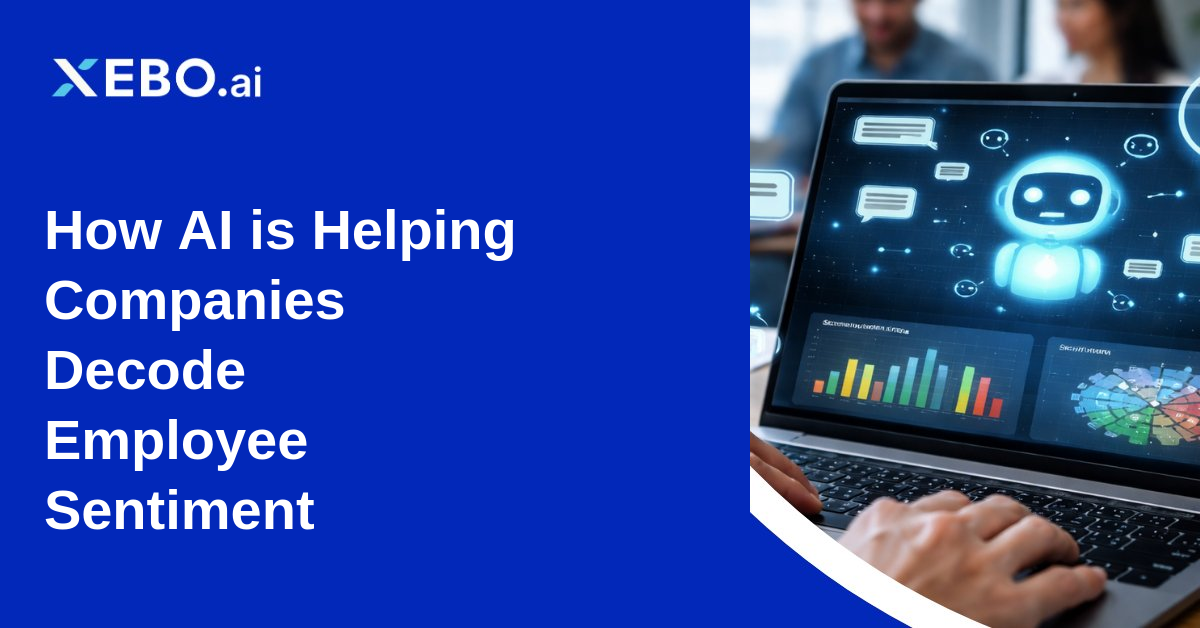
AI changes that equation entirely. Natural Language Processing (NLP) models can read and interpret thousands of open-ended responses, Slack messages (with consent), meeting transcripts, internal forum posts, and even performance review comments, in minutes. More importantly, they can detect nuances: frustration buried in polite language, enthusiasm that masks burnout, or disengagement hiding behind professional tone.
Sentiment analysis models trained specifically on workplace communication have become sophisticated enough to go beyond positive/negative/neutral classifications. They can now identify specific emotional themes, like anxiety about leadership changes, excitement around new projects, or a sense of fairness (or unfairness) in how decisions are made.
It's worth being specific here, because "AI for HR" is a phrase that gets thrown around without much clarity. Here's what modern AI sentiment platforms are capable of:
Real-time feedback loops. Instead of waiting for the annual survey, AI tools can run continuous micro-surveys, analyse responses instantly, and surface emerging issues before they escalate. If a particular team is showing signs of stress or disengagement, managers can know about it within days.
Theme and topic extraction. AI doesn't just tell you sentiment is declining. It tells you why, identifying recurring themes like workload concerns, management communication, lack of career development, or work-life balance issues. This makes feedback immediately actionable.
Segmentation without bias. One of the subtlest advantages of AI analysis is that it doesn't have the confirmation biases that human analysts sometimes bring. It surfaces patterns across departments, geographies, tenure groups, and roles without cherry-picking what fits a pre-existing narrative.
Predictive signals. Advanced models can identify sentiment patterns that historically precede attrition. If the language employees use starts resembling patterns from people who left in the past, the model flags it. This gives HR teams a window of opportunity to intervene, often before the employee has even made up their mind.
Anonymous but granular. AI can analyse trends at a team or department level without exposing individual identities, striking the balance between organisational insight and employee privacy.
A concern worth addressing directly: AI in HR raises legitimate questions about surveillance and trust.
The goal of AI sentiment analysis should never be to monitor employees in a way that feels invasive or punitive. When implemented transparently, with employees knowing how their feedback is used and having genuine anonymity assurances, AI tools build trust because they demonstrate that the organisation is listening and acting.
The most effective use of this technology is to hand better intelligence to the humans who need it most: HR leaders, people managers, and executives. The AI does the heavy lifting of pattern recognition across vast amounts of data. The human then decides what to do about it, having a thoughtful conversation, redesigning a process, changing a policy.
AI provides the what and the where. Humans still provide the why and the what next.
The business case for decoding employee sentiment isn't abstract. Consider a few realities:
Replacing an employee typically costs between 50% to 200% of their annual salary when you factor in recruitment, onboarding, and lost productivity. If AI sentiment tools help reduce voluntary attrition even by 10-15%, the ROI is substantial.
Disengaged employees cost organisations enormous sums in lost productivity each year. Catching disengagement early, when it's still reversible, is among the highest-value interventions an HR team can make.
There's also a compounding cultural benefit. When employees see that their feedback leads to visible, meaningful change, they become more likely to give honest feedback in the future. It creates a positive loop: better data leads to better decisions, which builds more trust, which generates better data.
Companies that invest in truly understanding their people don't just retain talent better. They make better decisions across the board, because they're building on an honest foundation.
Forward-thinking companies are weaving AI sentiment analysis into their people strategy in practical ways.
Some are embedding sentiment check-ins directly into existing workflows, a short pulse at the end of a project sprint, a quick post-onboarding reflection, a lightweight monthly check-in that takes under two minutes to complete. These are small asks that, in aggregate, generate rich data.
Others are using AI to analyse language patterns in performance conversations and 360-degree feedback cycles, not to surveil, but to identify systemic issues. If feedback consistently uses passive or vague language in a particular team, that itself is a signal worth investigating.
HR business partners are using AI-generated sentiment dashboards in their regular meetings with business leaders, moving the conversation from "here's the engagement score" to "here's what our people are actually telling us, and here's where we need to focus."
The companies doing this well share a common trait: they treat the AI insight as a starting point for conversation, not a substitute for it.
We are still in the early innings of this technology's potential. The next few years will bring sentiment models with deeper cultural and contextual awareness, better multilingual capabilities for global organisations, and tighter integration with broader HR systems, linking sentiment signals to performance data, absenteeism patterns, and learning & development engagement.
The vision is an organisation that is continuously self-aware, one that doesn't wait for problems to become crises before addressing them. Where people leaders have the same quality of intelligence about their workforce that marketing teams have about their customers.
It's not a utopian idea. It's a practical, achievable goal, and the tools to get there exist today.
Talent has always been the defining competitive advantage. But you can't develop, retain, or inspire talent you don't understand.
AI is finally giving organisations the ability to understand their people at the scale and depth that modern workplaces demand. Not through surveillance, but through smarter listening. Not through replacing human judgment, but through informing it with better intelligence.
The companies that embrace this shift, that build a genuine culture of listening, backed by the analytical power of AI, will be the ones that attract the best people, keep them longer, and unlock the kind of discretionary effort that no job description can mandate.
XEBO.ai helps organisations go beyond surface-level engagement scores to decode the real sentiment, emotions, and experiences of their workforce, with AI-powered tools built for action, not just insight.
Schedule a Free Demo with XEBO.ai today and see how intelligent employee sentiment analysis can transform the way your organisation listens, responds, and grows.