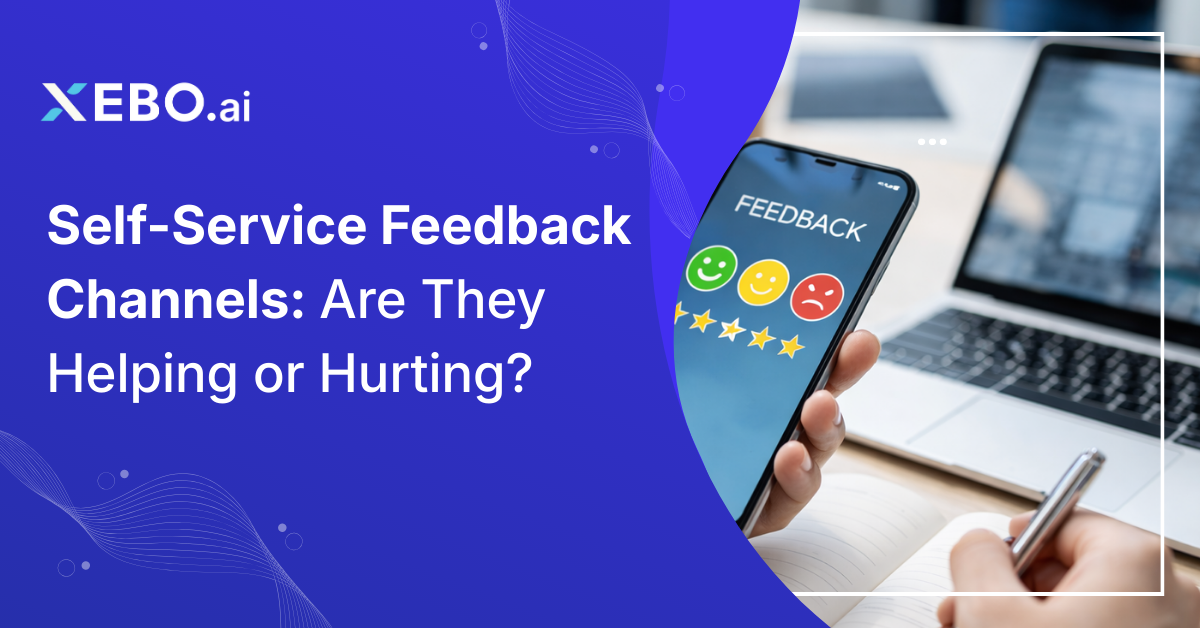
The digital age has introduced a wave of self-service options across industries, from banking to retail, and customer and employee feedback is no exception. Self-service feedback channels, such as in-app surveys, website pop-ups, chatbot-based forms, and employee portals, are now widely used to gather real-time insights from customers and employees. But as organizations increasingly rely on these tools, a pressing question arises: are self-service feedback channels truly helping improve customer experience and employee experience, or are they causing more harm than good?
This blog dives deep into the pros, cons, and best practices for implementing self-service feedback tools and how a robust feedback management platform like XEBO.ai can bridge the gap.
Self-service feedback channels offer several immediate advantages:
1. Speed and convenience
Organizations can deploy surveys in minutes using a survey management platform, targeting users at various touchpoints such as checkout pages, support chats, or internal portals. This quick deployment enables faster data collection and insights, essential for agile decision-making.
2. Scalability
Self-service tools can collect feedback from thousands of users without requiring manual effort. Whether you’re running a global enterprise or a mid-sized firm, you can use customer survey platforms or employee survey software to reach your entire audience effortlessly.
3. Cost-effectiveness
Unlike traditional feedback collection methods such as interviews or focus groups, self-service channels reduce the need for dedicated human resources. Automated data collection through a voice of customer platform (VoC platform) or employee experience software helps save both time and budget.
4. Real-time monitoring
Modern feedback management platforms allow real-time tracking of sentiment and trends. CX and HR teams can receive alerts when Net Promoter Score (NPS) drops or when negative feedback spikes, empowering them to act quickly.
Where self-service channels fall short
Despite these benefits, many organizations fall into the trap of overusing or misusing self-service channels. Here’s where things can go wrong:
1. Survey fatigue
Customers and employees alike are bombarded with survey requests, after every purchase, chat interaction, or support call. This leads to low response rates and survey fatigue, especially when using poorly designed forms or too many questions.
2. Lack of context
Self-service feedback often lacks the rich qualitative context needed for in-depth insights. For instance, a one-word answer to an NPS question can leave teams guessing about the root cause of dissatisfaction. Without proper tagging or follow-ups, even the best NPS tool can fall flat.
3. One-size-fits-all approach
Generic survey templates and robotic messaging can alienate users. Without personalization or relevance to their experience, respondents may view feedback requests as intrusive or meaningless.
4. Data silos and underutilization
Even when feedback is collected, it’s often trapped in disconnected systems, some in the customer experience software, others in the HR portal or employee engagement platform. Without a unified VoC platform or employee experience software to analyze and act on the data, insights go unused.
Self-service feedback can be a game-changer when implemented thoughtfully. Here are some best-in-class use cases:
1. In-the-moment feedback
A retail brand uses a survey management platform to collect customer satisfaction data at the point of sale or app checkout. Immediate feedback allows the CX team to detect friction points instantly.
2. Employee pulse surveys
A healthcare company uses employee survey software to run monthly pulse surveys focused on workload, morale, and wellbeing. Results are aggregated in a dashboard, giving HR leaders real-time insights to improve employee experience.
3. Closed-loop systems
An airline integrates the voice of customer platform into its customer service workflow. When a low satisfaction score is submitted, it triggers an automatic follow-up from the support team, ensuring resolution and retention.
4. Journey mapping and segmentation
Companies using advanced customer experience software segment users based on behavior, purchase history, or support interactions. Tailored surveys then collect more meaningful feedback, resulting in higher engagement and actionable data.
When self-service hurts: Cautionary tales
On the flip side, misaligned self-service strategies can backfire:
1. The invisible feedback void
A SaaS company deploys feedback widgets across its platform but fails to integrate the data with their CRM or product teams. The feedback becomes noise instead of insight, with no ownership or accountability.
2. Internal backlash
An enterprise HR team launches a lengthy annual survey using outdated employee experience software. The survey takes 30 minutes to complete, and employees feel it’s a box-checking exercise. Trust erodes, participation drops, and leadership never acts on the results.
3. Over-surveying high-value customers
A luxury brand targets VIP customers with the same generic feedback request after every interaction. Eventually, these customers disengage entirely, harming both loyalty and brand perception.
The way forward: Smarter self-service with integrated platforms
The key to leveraging self-service channels effectively is thoughtful integration, design, and action. Here’s how organizations can make the most of their feedback strategy:
1. Use intelligent triggers
Replace blanket surveys with contextual triggers. For instance, only ask for feedback after a support ticket is resolved or when a customer completes a specific journey milestone.
2. Consolidate feedback in one platform
Break down silos by adopting an all-in-one voice of customer platform like XEBO.ai. A centralized feedback management platform ensures all teams, from product to HR, can access and act on insights.
3. Close the loop
Always acknowledge feedback, especially negative comments. Use automated workflows in your customer experience software or employee survey software to notify relevant stakeholders and respond to users.
4. Prioritize quality over quantity
Instead of asking more questions, ask better questions. Combine structured surveys with text analysis tools to extract meaning from open-ended feedback. This hybrid approach is especially useful for those looking for a Qualtrics alternative or Medallia alternative.
5. Track and benchmark performance
Utilize dashboards to monitor NPS, satisfaction, and engagement over time. The best NPS tools and VoC platforms will allow benchmarking against industry standards, helping teams refine strategies.
Self-service feedback channels are neither inherently helpful nor harmful. Their impact depends entirely on how they are designed, implemented, and followed through. When used strategically, they can be a powerful extension of your customer experience and employee experience strategies. But when misused or disconnected, they can add to the noise, alienate users, and lead to missed opportunities.
If your organization is looking for a smarter, more unified approach to collecting, analyzing, and acting on feedback, whether from customers or employees, it's time to rethink your feedback stack. A modern, integrated survey management platform that combines agility, intelligence, and automation is no longer optional. It’s essential.
Schedule a free demo with XEBO.ai today and see how the best VoC platform can transform your feedback strategy into a growth engine.